
XSCAVE has made progress across its six objectives, from high-fidelity simulation and safe AI-based control to real-world demonstrations and industrial uptake.
High-fidelity simulators and differentiable models
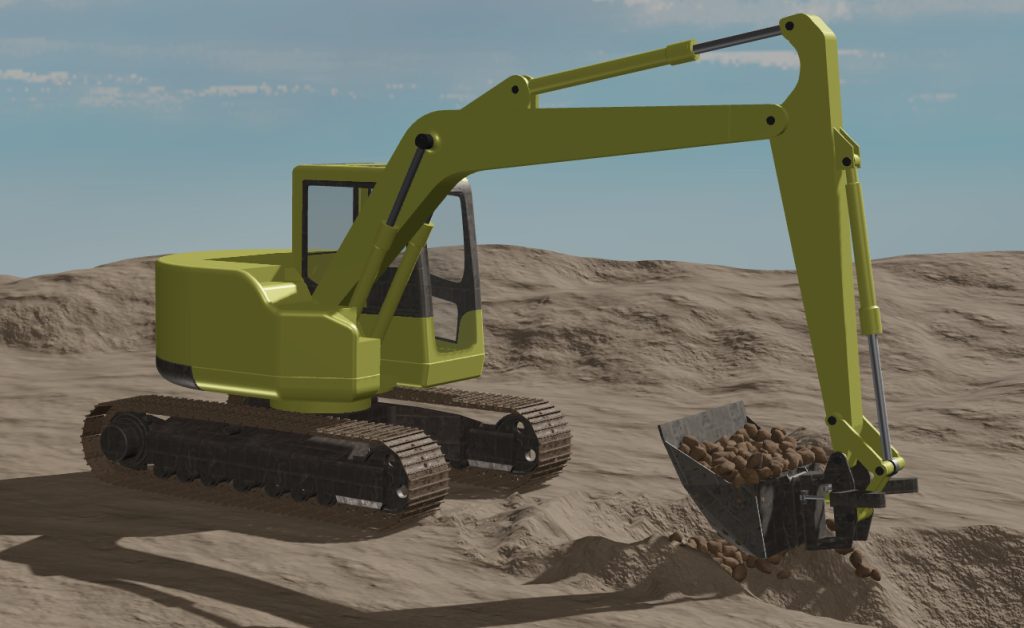
XSCAVE developed simulation environments and differentiable machine–terrain interaction models for excavation, forestry, and navigation. Digital twins of the Komatsu excavator, Komatsu forwarder, and Indigotech vehicle were integrated with deformable-terrain simulation.
Three simulation environments are under development, while differentiable modelling covers more than ten terramechanics and driveline parameters. Fast neural surrogate models and differentiable physics engines support real-time learning, planning, and control.
Safe perception-to-action learning
The project created learning and control frameworks that embed safety constraints directly into AI architectures. These include Continuous Monte Carlo Graph Search, differentiable optimisation layers, gradient-free optimisation methods, and Control Barrier Functions.
The tools support real-time decision-making while maintaining stability and collision avoidance. Current inference speeds meet project targets at approximately 10–60 milliseconds, depending on the task.
Data-efficient sim-to-real adaptation
XSCAVE developed online terrain adaptation, self-supervised learning, and risk-aware model predictive control to update models during operation.
The risk-surrogate approach requires significantly fewer samples than conventional methods while maintaining safety on slippery, snowy, and icy terrain. Initial validation shows promising improvements in sample efficiency and safety performance.
Trustworthy human–robot interaction
Reinforcement learning policies are converted into interpretable symbolic models that explain decisions and identify causal relationships between inputs and actions. Large Language Model-based interfaces also allow operators to ask questions and provide feedback.
Early evaluations achieved 69% explanation accuracy in simulated manipulation tasks, exceeding the project target of 60%.
Demonstrating increased autonomy
XSCAVE is preparing real-world demonstrations in excavation, forestry, and logistics. Excavators, forwarders, logistics vehicles, and wheel loaders have been equipped with integrated AI, perception, planning, and safety systems.
The public FORWARD and ROUGH datasets have also been created. Demonstration activities have not yet started, so KPI results are not available at this stage.
Exploitation and industrial uptake
XSCAVE promotes industrial adoption through dissemination, commercialisation planning, and stakeholder engagement. The project has launched a website, released datasets, and published research in robotics and automation venues.
Five commercially viable assets have been identified, including simulation technologies, operator-assistance solutions, navigation technologies, and explainable AI controllers. A detailed exploitation plan will be finalised by project month 36.